
Alternative Risk Solutions
Traditional insurance is not always the only answer.
As organizations grow, their approach to risk financing may need to evolve.
Traditional guaranteed-cost insurance can provide simplicity and predictability, but it may not always be the most efficient structure for organizations with sufficient scale, financial strength, risk-management discipline and loss predictability.
Insurance is one way to finance risk.
The Duncan Group helps clients evaluate whether alternative structures deserve consideration and coordinates the appropriate expertise when they do.
Not every dollar of risk needs to be transferred.
Insurance is a form of risk financing. The question is not simply:
“How much insurance should we buy?”
The more useful question may be:
“What risks should we transfer, what risks should we retain and what structure best supports the organization’s financial objectives?”
Avoid
Some exposures can be removed from the business entirely.
Reduce
Some can be lowered through operational change and loss prevention.
Retain
Some are economically retained rather than transferred.
Transfer
Some belong with an insurer or in a contract.
Finance
Some are funded through deductible, loss-sensitive or captive structures.
Alternative Risk Solutions are about determining the appropriate balance.
Guaranteed cost still has a place.
Traditional guaranteed-cost insurance can be the right structure for many organizations.
The objective of Alternative Risk Solutions is not to eliminate traditional insurance. It is to determine whether another structure could better align cost, control and risk retention with the client’s objectives.
It may offer
- Simplicity
- Predictable premium
- Limited retained volatility
- Straightforward administration
- Easier budgeting
Alternative risk requires the right foundation.
Characteristics that may support deeper analysis. These are not eligibility thresholds.
- Meaningful insurance premium
- Stable operations
- Predictable loss patterns
- Strong balance sheet
- Positive cash flow
- Management discipline
- Mature safety practices
- Willingness to retain risk
- Long-term strategic horizon
- Quality loss data
- Claims-management discipline
- Willingness to invest in loss prevention
Alternative does not automatically mean better.
Higher risk retention can create opportunity. It can also create volatility. Alternative structures may not be appropriate for organizations that:
- Prioritize maximum cost certainty
- Lack sufficient financial capacity
- Have highly volatile losses
- Lack reliable loss data
- Are unwilling to invest in risk management
- Have short-term ownership horizons
- Cannot support collateral requirements
- Are uncomfortable retaining meaningful risk
Our role is not to force clients into alternatives. It is to evaluate them intelligently.
The risk financing spectrum
From lower retention to higher retention.
- 01
Guaranteed cost
- 02
Large deductible
- 03
Loss-sensitive
- 04
Group captive
- 05
Single-parent / cell captive
- 06
Self-insurance
A conceptual spectrum only. No structure is inherently superior; the appropriate point depends on the organization.
It depends on
- Financial capacity
- Loss predictability
- Appetite for volatility
- Collateral
- Claims capability
- Premium scale
- Strategic horizon
- Risk-management maturity
Structures
Large deductible programs
Large deductible programs can allow an organization to retain a greater portion of predictable losses while transferring more severe losses to the insurance carrier.
This structure may provide greater participation in the economics of the risk, but it also creates greater retained exposure.
Potential considerations
- Cash flow
- Collateral
- Loss predictability
- Claims administration
- Reserve development
- Risk tolerance
- Safety performance
Loss-sensitive programs
Loss-sensitive structures tie some portion of insurance cost to actual loss performance. Examples may include retrospective rating, sliding-scale structures and other performance-sensitive arrangements.
These structures may reward stronger loss performance, but they can also introduce additional cost volatility. The decision should be based on data, risk tolerance and financial objectives—not simply the possibility of lower upfront premium.
Potential examples
- Retrospective rating
- Sliding-scale structures
- Other performance-sensitive arrangements
Group captives
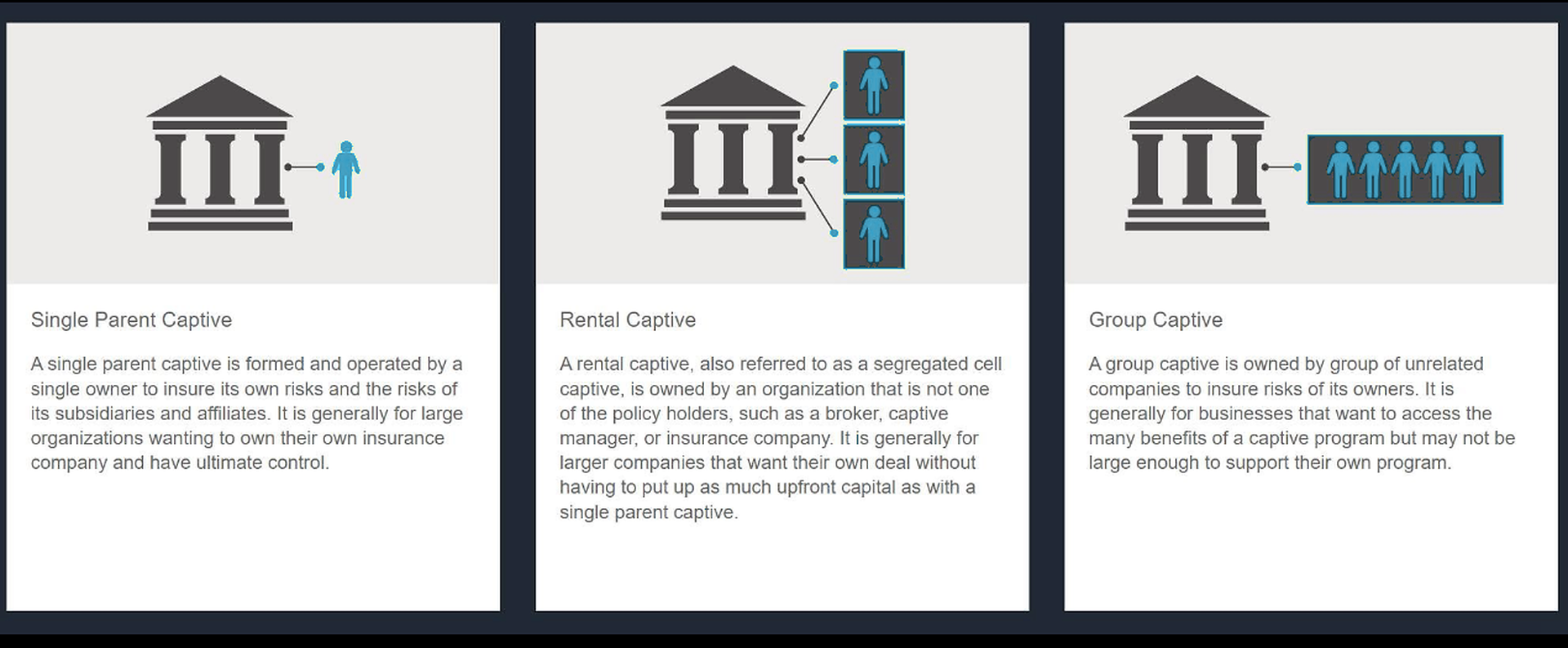
A group captive allows participating organizations to share certain risks within a structured insurance arrangement.
For the right organization it can provide greater control, increased transparency, potential participation in underwriting results, stronger alignment between safety performance and long-term cost, and access to a structured peer risk-financing environment.
Participation may also involve collateral, capital commitment, retained volatility, membership requirements, governance responsibilities and a long-term commitment. We help clients evaluate whether a group captive deserves consideration and coordinate with specialized captive professionals where appropriate.
What participation may involve
- Collateral
- Capital commitment
- Retained volatility
- Membership requirements
- Governance responsibilities
- Long-term commitment
Single-parent captives
A single-parent captive is an insurance company created to finance risks of its parent organization and related entities. This may provide customized risk financing, increased control, direct access to reinsurance markets, potential financial efficiency and flexibility in funding certain risks.
It also introduces capital requirements, governance, regulatory obligations, actuarial analysis, tax considerations, captive management and long-term administration. We do not present single-parent captives as a simple insurance replacement; they require specialized evaluation.
What it introduces
- Capital requirements
- Governance
- Regulatory obligations
- Actuarial analysis
- Tax considerations
- Captive management
- Long-term administration
Cell and rent-a-captive structures
Cell structures can provide access to captive-style risk financing without requiring every organization to establish a standalone captive entity.
Specific structures vary materially. The Duncan Group coordinates with specialized captive professionals when evaluating these options.
Potential advantages
- Lower administrative burden
- Access to captive infrastructure
- Greater flexibility than guaranteed-cost insurance
- Participation in retained risk
Self-insurance
Self-insurance places greater financial responsibility for losses directly on the organization.
For the right risk, this can increase control. For the wrong risk, it can create material financial volatility.
Key considerations
- Loss frequency
- Loss severity
- Cash flow
- Regulatory requirements
- Claims administration
- Stop-loss protection
- Collateral
- Financial capacity
The first question is not “can we form a captive?” It is “should we?”
A serious captive evaluation should consider more than premium size. The Duncan Group helps clients think through the strategic questions that should come before a captive feasibility study.
Where further analysis is warranted, we coordinate with specialized captive experts for formal feasibility, actuarial, legal, tax and captive-management work.
Potential areas
- Current premium
- Historical losses
- Expected losses
- Volatility
- Lines of coverage
- Risk-management maturity
- Financial capacity
- Collateral
- Ownership horizon
- Management appetite
- Claims control
- Strategic objectives
Specialized structures require specialized expertise.
Alternative risk financing can involve disciplines that extend beyond traditional insurance brokerage. The Duncan Group coordinates with specialized strategic partners when these capabilities are required; we do not perform them directly.
- Actuarial analysis
- Captive management
- Legal counsel
- Tax advisory
- Accounting
- Regulatory compliance
- Reinsurance
- Claims administration
- Banking and collateral
Our role is to help connect the strategy.
- Evaluating whether alternative structures should be considered
- Reviewing the current insurance program
- Organizing loss data
- Analyzing risk-retention philosophy
- Identifying potential structures
- Coordinating specialized advisors
- Comparing traditional and alternative options
- Integrating the structure into the broader risk-management strategy
- Supporting ongoing stewardship
The goal is not to create complexity. It is to determine whether a different risk-financing structure can create strategic value.
The decision should be based on total cost of risk.
- 01
Traditional premium
- 02
Retained losses
- 03
Collateral cost
- 04
Claims administration
- 05
Capital requirements
- 06
Risk management expense
- 07
Volatility
- 08
Administrative cost
- =
Total cost of risk
The lowest stated premium is not always the lowest total cost.
Alternative structures should be evaluated on the complete economic picture, while recognizing that not every element can be precisely quantified in every case.
More retention creates more responsibility.
As organizations retain more risk, claims discipline becomes increasingly important.
- Claim reporting
- Reserving
- Litigation management
- Return-to-work
- Medical management
- Vendor selection
- Claim reviews
- Trend analysis
- Corrective action
Alternative risk rewards discipline.
Organizations that retain more of their own risk have a direct financial interest in preventing losses and managing claims effectively. That makes risk management central to the strategy.
Risk financing is a long-term decision.
Alternative structures can require multi-year commitment, capital and disciplined execution. They should not be selected solely because a traditional renewal became expensive.
Alternative risk + private equity
Private equity sponsors and portfolio companies may evaluate risk financing differently depending on how the portfolio is structured and held.
The Duncan Group can help evaluate whether traditional or alternative structures may be appropriate across individual portfolio companies or broader programs. This is risk-financing coordination, not investment, tax or legal advice.
Factors
- Ownership horizon
- Portfolio scale
- Concentration
- Loss experience
- Transaction strategy
- Capital structure
- Shared services
- Risk aggregation
Should we explore alternative risk?
- 01
Are premiums large enough to warrant deeper analysis?
- 02
Are losses reasonably predictable?
- 03
Is management willing to retain more risk?
- 04
Does the organization have strong safety and claims discipline?
- 05
Can the balance sheet support volatility?
- 06
Can the organization support collateral?
- 07
Is leadership thinking long-term?
- 08
Does the organization want greater control over risk financing?
If several of these questions suggest potential alignment, a deeper feasibility discussion may be worthwhile. These questions are a starting point for conversation — not a score, an eligibility determination or financial advice.
The goal is not simply a lower premium.
A successful strategy may create
- Greater control
- More transparency
- Better alignment with loss performance
- Improved cash-flow economics
- Increased ownership of underwriting results
It can also introduce
- Volatility
- Collateral
- Capital commitments
- Administrative responsibilities
- Long-term obligations
The objective is the right structure—not automatically the cheapest one.
Alternative risk intelligence
Coverage areas within RiskThoughts. Pieces are in preparation.
- Captives
- Group Captives
- Risk Financing
- Large Deductibles
- Loss-Sensitive Programs
- Self-Insurance
- Total Cost of Risk
- Collateral
- Claims
- Risk Retention
Alternative risk requires a different mindset.
These structures work best for organizations willing to think about insurance as part of a broader financial and risk-management strategy. They require discipline, data and a willingness to participate in the economics of risk.
For organizations that want maximum predictability and minimum retained exposure, traditional insurance may remain the better answer.
Discuss your risk financing strategy.
Tell us what you spend today, how your losses behave and how much risk the organization is prepared to own.